For a long time, America treated certain kinds of chemistry like a haunted house. We knew there was something powerful inside, but the political cost of opening the door felt higher than the scientific reward. Psychedelics were pushed into the shadows of the culture wars. Peptides became the domain of bodybuilders, anti-aging clinics, and gray-market biohackers. Serious researchers were often left peering through the window.
That is starting to change.
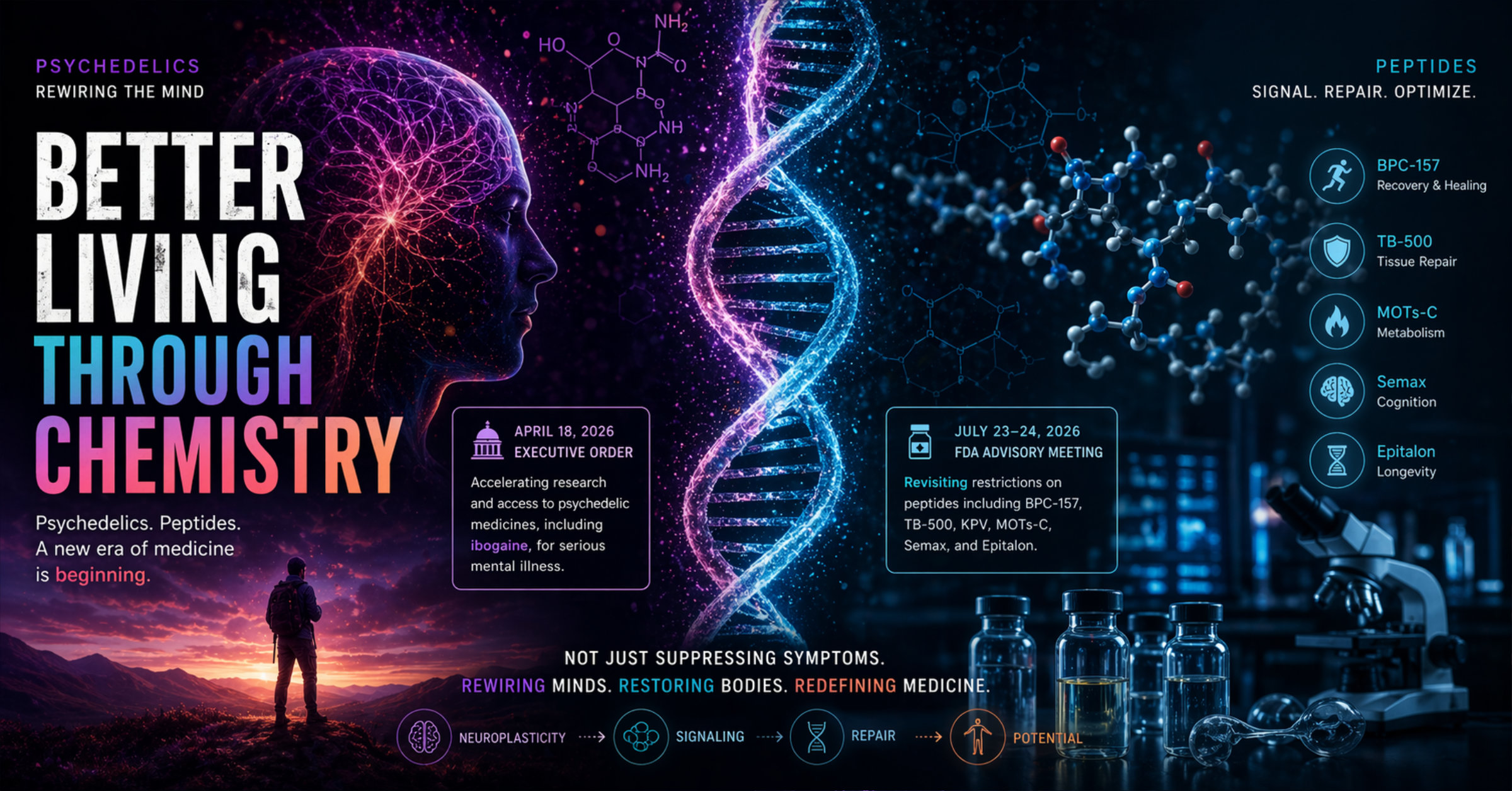
On April 18, 2026, President Trump signed an executive order titled "Accelerating Medical Treatments for Serious Mental Illness." It directs federal agencies to speed research and review of psychedelic medicines, including ibogaine. Just days earlier, in mid-April 2026, the FDA signaled it would revisit restrictions on several unapproved peptides and scheduled a July 23-24, 2026 advisory committee meeting to discuss compounds like BPC-157, TB-500, KPV, MOTs-C, Semax, and Epitalon.
Two very different stories? Maybe on the surface. But beneath them is the same bigger theme: medicine is beginning to rediscover molecules that do not simply suppress symptoms. They modulate signals. They may help the brain rewire itself. They may help the body repair, regulate, and recover in ways our older drug playbook never handled very well.
Psychedelics Step Out of the Penalty Box
The most important detail in the psychedelic story is not that Washington suddenly became counterculture. It did not. The important detail is that the federal government is finally acknowledging that the old posture of near-total friction has been blocking legitimate research.
Trump's April 18 executive order does not legalize psychedelics. It does not make ibogaine an approved therapy. But it does something significant: it tells the FDA and DEA to establish a pathway under the Right to Try Act for eligible patients to access psychedelic drugs, including ibogaine compounds. It directs HHS to put at least $50 million of existing ARPA-H funds toward state partnerships advancing psychedelic treatments for serious mental illness. It also tells HHS, FDA, and the VA to expand clinical-trial participation, data sharing, and real-world evidence generation, while prioritizing drugs that already have Breakthrough Therapy status.

That is real movement.
Ibogaine in particular has become a flashpoint because veterans and some clinicians believe it may help where existing treatments have failed, especially around PTSD, traumatic brain injury, addiction, depression, and the kind of despair that calcifies into something chronic. A small Stanford-led study published in Nature Medicine in 2024 reported striking improvements in functioning, PTSD, depression, and anxiety among 30 special operations veterans treated with magnesium-ibogaine in Mexico. But the study was not randomized, had no placebo group, and followed patients only for a short period. That makes it promising, not definitive.
And that distinction matters because ibogaine is not a harmless miracle hiding in plain sight. It has well-documented cardiac risks. The NIH once backed away from it because of cardiovascular toxicity concerns. So the bullish case here is not "everyone was wrong and the biohackers were right." The bullish case is that the country is finally making room to run the kinds of careful studies that should have been easier to do years ago.
That broader psychedelic story is bigger than ibogaine. Psilocybin already received FDA Breakthrough Therapy designations in 2018 and 2019 for depression-related indications. The FDA published draft guidance in 2023 for clinical investigations involving psychedelic drugs. In other words, this field was already creeping toward legitimacy. The executive order matters because it turns a slow institutional thaw into a much louder policy signal.
The Peptide Craze Was Never Just About Ozempic
If psychedelics are the rebellious cousins coming back into the family photo, peptides are the overlooked insiders who suddenly became celebrities.
Ozempic, Wegovy, Mounjaro, and Zepbound changed public perception almost overnight. Semaglutide is a GLP-1 analog. Tirzepatide is a dual GIP and GLP-1 receptor agonist. These are peptide drugs, and their success did something profound: they taught millions of people that short chains of amino acids can produce enormous, life-changing effects in the human body. Not vague wellness effects. Real, measurable shifts in appetite, blood sugar, body weight, and metabolic health.
Once that happened, a much wider cultural question followed: if these peptides can do that, what else is sitting on the shelf?
That question spilled into podcasts, longevity clinics, compounding pharmacies, startup culture, and places like Reddit's r/Biohackers, where people trade protocols, anecdote, skepticism, and a lot of chemical optimism. The list of molecules people became fascinated with is long: BPC-157 for injury recovery, TB-500 for healing, MOTs-C for metabolism, Semax for cognition, Epitalon for longevity, DSIP for sleep, KPV for inflammation.
Some of that fascination is grounded in real biology. Peptides are, in a very literal sense, one of the body's native languages. They act as signaling molecules. They tell cells when to grow, when to slow down, when to release hormones, when to change appetite, when to heal, and when to adapt. But the cultural leap from "this is biologically plausible" to "this works safely in humans" is exactly where the trouble starts.

That is why the latest FDA moves are so important, and why they need to be described accurately. The agency has not simply blessed these compounds. What it has done, as of mid-April 2026, is reopen a path for formal reconsideration. The FDA updated its 503A compounding categories and announced that on July 23-24, 2026, its Pharmacy Compounding Advisory Committee will discuss several peptide-related substances, including BPC-157, KPV, TB-500, MOTs-C, Emideltide (DSIP), Semax, and Epitalon, and whether they should be included on the 503A bulks list.
That sounds technical, but the implications are large. It means some of the compounds that were pushed toward the gray market may once again be argued for inside a regulated framework.
Still, let's be honest about the evidence gap. The FDA's own safety-risk summaries remain stark. For BPC-157, KPV, MOTs-C, Semax, Epitalon, and others, the agency says human safety data are absent or very limited, and in some cases it specifically notes concerns about immunogenicity, peptide-related impurities, and lack of information about harm in humans. A recent narrative review of BPC-157 reached a similar conclusion: strong preclinical interest, almost no meaningful human data.
So yes, this is a loosening. But it is a loosening into argument, review, and evidence-building. Not proof.
The Deeper Connection
This is where psychedelics and peptides start to rhyme.
Both sit at the frontier of signaling-based medicine.
Older medicine often worked like a hammer. Kill the pathogen. Block the receptor. Sedate the symptom. Lower the number. Those are still essential tools, but they are blunt. Psychedelics and peptides represent a different ambition. They are not just trying to overpower biology. They are trying to speak its language.
Psychedelics appear to work, at least in part, by changing brain network dynamics and promoting neuroplasticity. The most interesting research in the field is not about the spectacle of the trip. It is about whether these compounds can help the brain escape rigid loops: depression, trauma, addiction, obsessive rumination, catastrophic forecasting, the mental grooves that get deeper every year.
Peptides operate through a similar philosophical lens, even if the mechanisms are totally different. They are often designed to mimic or modify endogenous signaling pathways. That is why semaglutide and tirzepatide feel so revolutionary. They do not simply punish the body into weight loss. They alter appetite signaling, gastric emptying, insulin response, and energy balance. They nudge the system.
That is the shared future hiding inside both stories: drugs that do less brute forcing and more instruction.
If that future arrives, it will not be because science suddenly became reckless. It will be because science finally gave itself permission to explore classes of molecules that were culturally distorted for decades, either by stigma on one side or by hype on the other.

The Real Risk Is Not Research. It Is Bad Research and Worse Incentives.
There is a wrong way to read this moment.
The wrong way is to decide that if the FDA loosens up, every underground claim has been vindicated. It has not. The wrong way is to let influencer testimonials outrun the data. It is to confuse a state pilot, a case series, a compounding hearing, or a podcast appearance with a completed medical verdict.
We do not need less rigor here. We need more of it, applied faster.
For psychedelics, that means larger randomized trials, tight cardiac screening where relevant, careful integration protocols, and honest long-term follow-up. For peptides, it means pharmaceutical-grade manufacturing, impurity analysis, human dose-finding, adverse-event surveillance, and a hard line between plausible mechanisms and proven outcomes.
The goal should not be to swap one medical priesthood for another. Not doctors for podcasters. Not clinical evidence for subreddit lore. The goal should be to widen the aperture of legitimate science so that promising compounds no longer have to live in a legal or cultural basement before they can be studied seriously.
Better Living, If We Do This Right
There is something unmistakably American about this moment.
For years we were told these frontiers were either too weird, too risky, too political, or too unserious to touch. And now, all at once, the walls are moving. Psychedelics are being discussed in the context of veterans, depression, and serious mental illness, not just counterculture. Peptides are being discussed not just as locker-room contraband or luxury longevity toys, but as part of a larger rethink of how precision molecules might regulate repair, metabolism, sleep, inflammation, and cognition.
This is not the end of the argument. It is the beginning of a better one.
If the Trump administration's April 2026 moves turn into real research pathways instead of headline theater, and if regulators can separate legitimate peptide science from the nonsense economy that formed around scarcity and gray markets, we may look back on this period as the moment medicine stopped treating certain molecules like taboo and started treating them like tools.
Unexplored territory is opening up again.
The future may not belong to the loudest ideology in the room. It may belong to the chemistries we were too afraid, or too arrogant, to study properly.
