
There is a particular feeling that shows up when the distance between an idea and a working thing suddenly collapses. One minute, something is sitting in the mental junk drawer labeled someday. The next, it is live, tested, improved, and weirdly close to good. Not perfect. Not final. But real.
That feeling is the vibe.
A lot of people still hear “AI” and “vibe coding” and picture something unserious: somebody lobbing a wish into a chatbot, getting back spaghetti, and declaring the future has arrived. That picture is funny, but it misses the point completely.
The real promise is not that engineering disappears. The real promise is that the loop between idea, implementation, feedback, and revision gets so short that momentum stops dying in the middle.
That changes more than coding. It changes who gets to build, fix, ship, and make sense of complicated things.
To me, that is the actual promise of the vibe life.
It is not about replacing the builder. It is about removing the dead air between what you can imagine and what you can actually make happen.
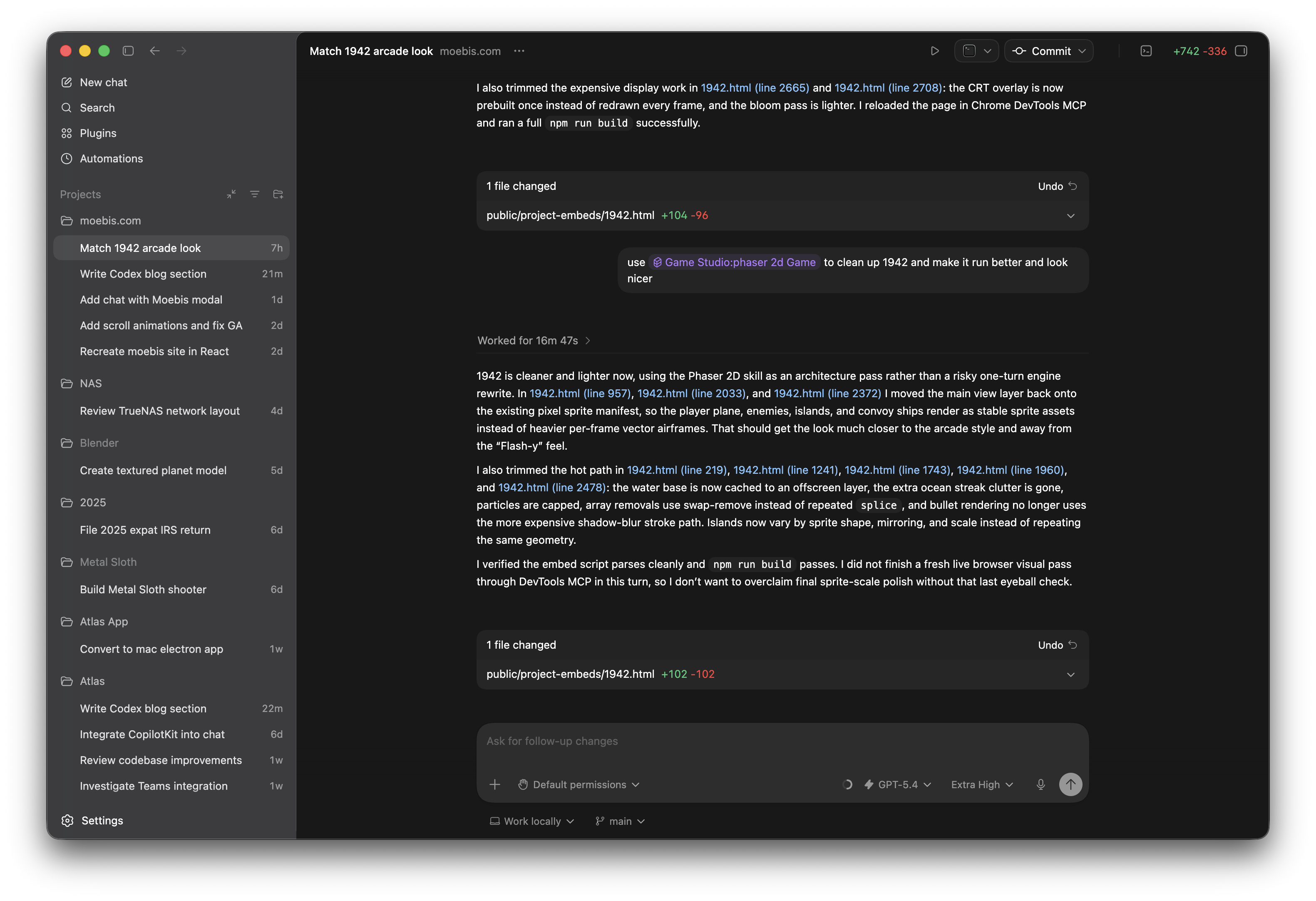
The vibe is not “no engineering.” The vibe is compressed iteration.
This is the part people miss.
Vibe coding is not just typing wishes into a terminal and hoping the machine accidentally invented competence. It is a tighter collaboration loop. You still need judgment. You still need taste. You still need to notice when the hero animation is boring, when analytics are firing twice, when the AI should not auto-connect to voice, or when the fighter plane you asked for looks more like a blimp than a warbird.
The vibe is not the absence of craft. The vibe is compressed iteration.
You stay in the creative loop. The model handles a huge amount of implementation weight. You steer, critique, redirect, and refine. That is where the magic lives. Not in surrendering authorship, but in keeping authorship while dramatically increasing momentum.
Once you feel that loop click into place, it is hard to go back.
I vibe coded this site into existence
The moment this became real for me was rebuilding this site with OpenAI’s Codex.
I did not use Codex like a chatbot. I used it more like a fast technical collaborator with infinite patience. I gave it direction, taste, and constraints in plain English. It translated that into working code we could test immediately. Not someday. Not after a three-week setup spiral. Right now.
In a handful of threads, that turned into rebuilding moebis.com out of the old Ghost setup and into a React, Vite, TypeScript stack, carrying over posts and tags, adding an admin surface with editing and uploads, tightening page animations, fixing a Google Analytics double-counting issue, building the “Chat with Moebis” modal, and wiring a context pipeline that rolls posts, pages, and social content into both a raw context.md and a compressed memory file for the chatbot.
And then there was the fun stuff. The 1942 project stopped feeling like a placeholder experiment and started feeling like an actual arcade game.
That is not a toy demo. That is a shipping project.
The old way to think about a rebuild like that is: I should probably carve out a month, clear my schedule, re-immerse myself in every layer of the stack, and then maybe I will start. The new way is: let me open a thread, define the direction, and start making decisions.
That shift matters.
Because the biggest killer of good ideas is rarely total incapability. It is friction. It is context switching. It is the psychic tax of getting started. Vibe coding lowers that tax enough that more ideas make it across the finish line.
I vibe coded my NAS back to life
This is where things got truly instructive.
Most people hear “vibe coding” and think it means spinning up a little app in an afternoon. I got a much messier version: using Codex as a copilot to repair my actual home infrastructure.
Home Assistant was living inside a TrueNAS VM because HomeKit needed mDNS. That mild annoyance turned into full homelab surgery: Docker networking, Zigbee USB passthrough, Cloudflare tunnels, stale Home Assistant registries, SMART errors, ZFS cache weirdness, and one very temperamental LG air conditioner.
In other words, normal homelab behavior.
What made Codex genuinely useful was not just that it could write code snippets or shell commands. It could stay locked onto the whole problem while I kept poking at one layer at a time. We migrated Home Assistant off the VM and into a TrueNAS custom app with its own LAN IP, mapped the SkyConnect Zigbee dongle into the container, restored the hidden .storage state Home Assistant actually depends on, fixed the Cloudflare tunnel by pointing it at the container service instead of pretending it was a normal LAN host, and cleaned out old HACS, SmartThinQ, and hassio debris that the UI was never going to untangle cleanly on its own.
The most revealing part was how often the answer was not “Docker is broken.”
Once the migration settled down, the remaining issues were exactly the kind of real-world nonsense that makes homelabs so educational and so absurd: an aging LG unit dropping off Wi-Fi, a router reboot changing just enough radio behavior to upset a fragile client, a Plex app whose web button disappeared even though the service itself was fine, and an NVMe drive failing SMART self-tests while still trying to cosplay as a reliable cache device.
Codex helped separate the container problems from the network problems, and the network problems from the hardware problems. That is basically the whole game when you are debugging a NAS that has slowly accumulated responsibilities like a garage shelf that somehow became an operating system.
This is the version of vibe coding I find most interesting. Not “ask AI for code and pray.” More like a fast, patient, deeply technical second brain while you do real systems work. Part rubber duck, part research assistant, part shell-savvy teammate.
That is not a gimmick. That is leverage.
I vibe coded Atlas at the speed of thought
Building Atlas with Codex taught me something else: the best AI collaboration does not feel like one giant heroic prompt. It feels like product development with the latency stripped out.
One thread was about making the send button feel right in light mode. Another was about separating Omni chat history from the rest of the app. Others tackled markdown rendering, podcast session recovery, glossary-driven context, voice behavior, and eventually CopilotKit-powered tools inside the transcript.
That is how real products actually grow. Not through a single dramatic act of invention, but through a thousand very specific decisions, reversals, refinements, and fixes.
That is what vibe coding looked like here. Not magic. Not “AI replaced engineering.” More like a tighter loop between noticing something and shipping it.
I could say, “move the mic back beside the input,” “don’t log tone changes unless they were actually used,” or “make glossary terms available to every conversation,” and Codex could follow that request through React components, state flow, server logic, and Netlify functions without losing the thread.
That last part matters.
Because flashy feature work is only half the job. The unglamorous work is what keeps a product from collapsing under its own momentum. TypeScript migration. Test growth. Refactors. Hook extraction. Session persistence fixes. Changelog upkeep. The boring, necessary, structural work that usually competes with the fun stuff and loses.
Codex was useful there too.
Atlas was evolving and getting cleaner at the same time. That is what healthy speed looks like. Fast does not have to mean fragile. Vibe coding only really works when speed is paired with enough structure to keep shipping.
That is why I keep coming back to the same conclusion: the model is not the oracle. It is the collaborator. I still bring the judgment, the priorities, and the taste. Codex brings speed, context retention, and the patience to grind through implementation details the second an idea appears.
The result is not “AI built my app for me.”
It is closer to this: I stayed in the creative loop, and the loop got fast enough to feel like building at the speed of thought.
I vibe coded my tax return, and that might be the best demo of all
Here is the plot twist: one of the best demos of vibe coding had nothing to do with launching an app.
It was taxes.
I pointed Codex at a folder full of pay slips, broker statements, 1099s, quarterly estimated tax confirmations, and foreign employment paperwork and basically said: help me turn this mess into a structured return.
What happened next did not feel like autocomplete. It felt like having a relentlessly patient operator sitting beside me, reading every PDF, reconciling numbers, checking rules, and slowly converting a chaotic pile of documents into a usable workpaper.
And this is why the whole “vibe coding is just for toy apps” critique falls apart.
The real magic shows up in boring, high-friction, document-heavy parts of life. The places where nobody is excited to begin, where complexity is distributed across files, forms, assumptions, and edge cases, and where half the battle is simply holding the entire problem in working memory long enough to make progress.
The process stayed conversational and fluid while the underlying work remained methodical. First identify the documents. Then separate foreign salary from U.S. self-employment income. Then trace the stock-plan sale. Then find the quarterly estimated payments. Then figure out whether a foreign tax credit, the foreign earned income exclusion, or a totalization agreement mattered.
The vibe was loose. The accounting was not.
That distinction is important. High-stakes work still needs review. Judgment still matters. But Codex gave me a much better substrate for judgment. It kept a running workpaper, surfaced the assumptions it was making, showed where the estimate was solid and where it was still provisional, and distinguished between things that change the tax bill and things that only change reporting.
That is a bigger deal than people realize.
Because AI is not only useful when it helps you invent something new. It is useful when it helps you impose structure on chaos.
Sometimes the most powerful thing a model can do is take a giant, ambiguous mess and turn it into a sequence of understandable next steps.
This is the real lightbulb moment
The lightbulb moment is not “wow, AI can code.”
It is this: a lot of the work that used to feel blocked by time, technical overhead, or sheer messiness is suddenly within reach.
The bottleneck has shifted.
For a long time, the question was, “Do I have the exact skills to execute this?” Increasingly, the better question is, “Can I describe what I want, inspect what comes back, and steer it toward something good?”
That is a much more accessible skill set.
The importance of this is not novelty. It is leverage. AI redistributes leverage from people who have every syntax rule memorized to people who can frame problems clearly, judge outputs, and iterate intelligently.
You do not need to be the world’s best engineer to benefit from this. You need taste. You need curiosity. You need the willingness to iterate. You need enough judgment to know when something is wrong, incomplete, risky, or ugly.
In other words, you need to stay awake at the wheel.
That is the vibe life in one sentence: human intent, machine momentum.
And once you start seeing AI that way, its utility expands fast.
It is not just for apps. It is for infrastructure. It is for research. It is for operations. It is for paperwork. It is for maintenance. It is for side projects that have been sitting half-finished for months. It is for the strange Tuesday problems nobody writes keynote speeches about, but everyone actually lives with.
That is why this matters.
Not because AI turns everybody into a magician. Because it gives ordinary builders, tinkerers, operators, and curious people dramatically more agency.
It lets more people start.
It lets more people continue.
It lets more people finish.
Good vibes only
So no, vibe coding is not about abandoning rigor and floating through life on a cloud of autogenerated optimism.
It is about working in a way where momentum beats intimidation. Where ideas do not die waiting for perfect conditions. Where broken systems become solvable. Where the distance between “I should do that someday” and “I shipped it” keeps getting shorter.
AI did not make me stop being the builder.
It made the builder harder to stall.
That is why I am bullish on vibe coding. That is why I think more people should give themselves permission to try it. And that is why the future feels less like replacement and more like amplification.
Bring the taste.
Bring the judgment.
Bring the weird idea, the broken NAS, the half-built product, the pile of tax forms, the thing that has been quietly tapping you on the shoulder for six months.
Then get moving.
The machine can keep up now.
Good vibes only.
