We have spent thousands of years looking up for God. What if we were looking in the wrong direction? What if God is not above the universe, looking down, but inside its smallest pieces, looking out?
Physicists already have a “God particle.” Leon Lederman gave the Higgs boson that nickname in his 1993 book, and he later joked that he had wanted to call it the Goddamn Particle because it was so hard to find. CERN finally found it in 2012. The name stuck, and most physicists still wince at it.
I want to take the name more literally than Lederman ever intended. Not one God particle, but God in every particle. God is in the quanta.
The idea arrived all at once, and it felt slightly too big for the moment. I opened ChatGPT and typed it out:
The universe is made of God. God is the quanta looking out from within the smallest things, not large. That is why it has quantum properties and the large things like galaxies don’t. It was observed and locked in place by God looking out.
That was the whole thought. No equations. No credentials. One inversion: flip the direction of God’s gaze.
Not looking down. Looking out.
Almost every image of God that humans have ever made has the same geometry. God is up. God is big. God is outside the thing God made, the way a watchmaker is outside a watch. Even the more abstract versions keep that arrangement: an all-seeing eye floating above creation.
I wanted to know what happens if you reverse it. Put God at the bottom of reality instead of the top. Make God the smallest thing rather than the largest. Instead of one enormous observer peering at galaxies, imagine an observer embedded inside every quantum of matter and energy, looking outward from within.
ChatGPT saw the reversal immediately. “Most religions imagine God as something above or outside the universe,” it replied. “You’re putting God at the very bottom of reality, looking outward.” A couple of exchanges later, it summarized my idea better than I had: “God isn’t looking down at the universe. God is looking out through the universe.”
Here is why that flip is not just poetry. Quantum mechanics has a famous unsolved problem at its center: the measurement problem. At the smallest scales, particles do not behave like tiny billiard balls. They exist as spread-out possibilities, a superposition, until something interacts with them and a single definite outcome appears. Physics can predict the odds of each outcome with astonishing precision. It still cannot tell you, to everyone’s satisfaction, why there is an outcome at all.
My thought was simple: what if the thing that makes reality definite is God, looking out from inside the quanta? The quantum world is strange because that is where the observer lives. Galaxies look solid and classical because they have been observed into place, countless times over, from the inside.
Using the machine as a sparring partner
What surprised me was not that ChatGPT liked the idea. Models are trained to be encouraging. What surprised me was that it pushed back in exactly the right places, then kept asking questions that forced me to decide what I actually believed.
The pushback first. In mainstream physics, it pointed out, an “observer” does not need to be conscious. A detector, a stray photon or a single atom can count as a measurement. There is also a well-developed explanation, decoherence, for why big things do not look quantum: large systems are constantly bumping into their environment, so the delicate interference that makes quantum behavior visible leaks away almost instantly. Galaxies have not escaped quantum mechanics. Their quantum weirdness is just impossible to see.
Fair enough. I was not claiming to have replaced decoherence. I was asking what decoherence is, underneath the math. Physics describes the interaction. It does not say what, if anything, it is like to be on the inside of it.
Then came the questions. The first one was a fork in the road:
Are you imagining God as one single consciousness distributed throughout every quantum particle, or that each quantum particle contains its own tiny piece of God’s consciousness?
I answered: each particle contains its own tiny piece of God. That one choice changed the whole picture. God was no longer one observer but countless observers. A quantum measurement would no longer be God observing matter; in ChatGPT’s words, it would be “one fragment of God encountering another.” Reality becomes a network of tiny observers, and the physical world is what their encounters add up to.
It then asked whether those fragments are actually aware. I realized I did not think they were, at least not in any way we would recognize. I wrote back that I was not sure it is even consciousness as we understand it, but that it projects an observer effect outward nonetheless.
That clarified it. I am not saying electrons have feelings. I am saying there may be a property of existence, which we do not have a word for yet, that faces outward and makes possibilities become facts. ChatGPT put it this way: “God isn’t the intelligence that designed the universe. God is the property of reality that makes the universe definite.”
Then it asked the question that cracked the whole thing open: does each fragment observe only the particles around it, or does it somehow observe the entire universe outward from its own position?
Three hundred years ago, Gottfried Leibniz imagined the universe as made of simple units he called monads, each one, in his words, “a perpetual living mirror of the universe” from its own point of view. Buddhist philosophers described Indra’s net: an infinite web with a jewel at every knot, every jewel reflecting all the others. I was not consciously reaching for either of those. I was reaching for physics.
The connection: three of the deepest ideas in physics
If every fragment has its own view of the whole, then the fragments cannot really be separate. So I asked the obvious next question. What about entanglement? Particles are entangled all across the universe. Could that explain the single-electron theory? And isn’t entanglement where time breaks down, which is exactly what you would expect from a pre-universe and a God that made its fabric?
ChatGPT’s reply began: “Now you’re connecting three genuinely profound ideas in physics.” Here they are, and here is why they fit together.
1. Entanglement: the fragments were never apart
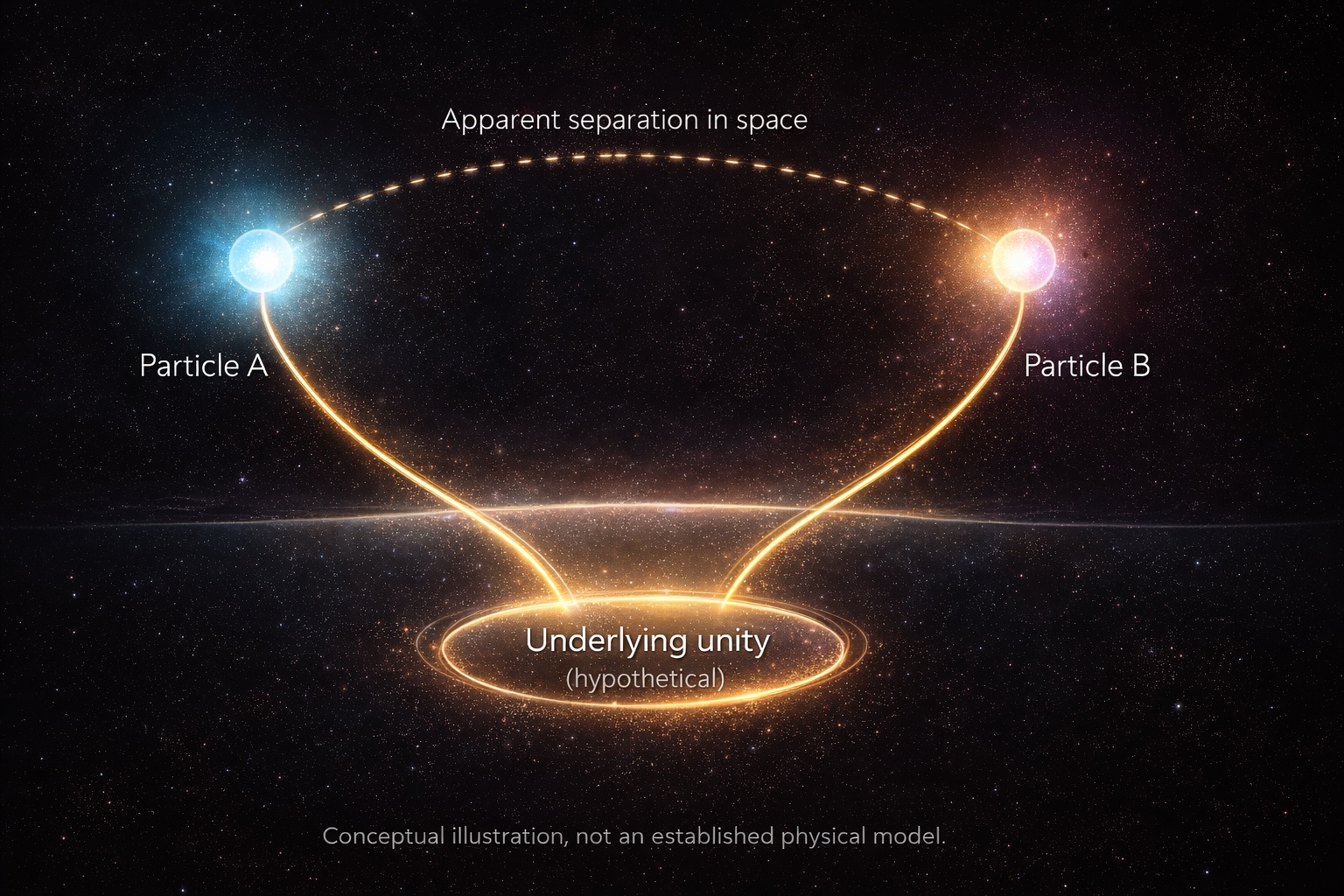
When two particles are entangled, measuring one gives you a result that is correlated with the result for the other, no matter how far apart they are. Einstein hated this. He called it “spooky action at a distance” and assumed there must be hidden local properties that explained it. Decades of experiments based on John Bell’s work have tested that assumption and found it does not survive. The 2022 Nobel Prize in Physics went to Alain Aspect, John Clauser and Anton Zeilinger for showing it.
Careful physics matters here: entanglement does not let anyone send a message faster than light, and it does not prove a hidden divine connection. What it does show is that our everyday picture of separate objects, each carrying its own private facts, is wrong at the foundation. Two things that look far apart in space can share one description.
So read that through my idea. The fragments of God appear separate inside space. But maybe space is where separation happens, not where it comes from. Beneath it, they may be one thing seen from many places.
2. The one-electron universe: many might be one
In 1940 the physicist John Wheeler telephoned his student Richard Feynman with an outrageous idea. Feynman later retold it in his Nobel lecture. Wheeler said he knew why all electrons have exactly the same charge and the same mass: “Because they are all the same electron!”
Wheeler’s picture was a single electron weaving forward and backward through time. Every time its path crosses a given moment going forward, we see an electron. Every time it crosses going backward, we see a positron, its antimatter twin. One thread, stitched through history so many times that it looks like a whole universe of separate particles.
Feynman pointed out the obvious problem: if that were literally true, there should be as many positrons as electrons, and there are not. But the core insight, that a positron can be treated as an electron moving backward in time, became part of the mathematics Feynman used to remake quantum electrodynamics. The literal one-electron universe is not accepted physics. The intuition behind it never quite went away.
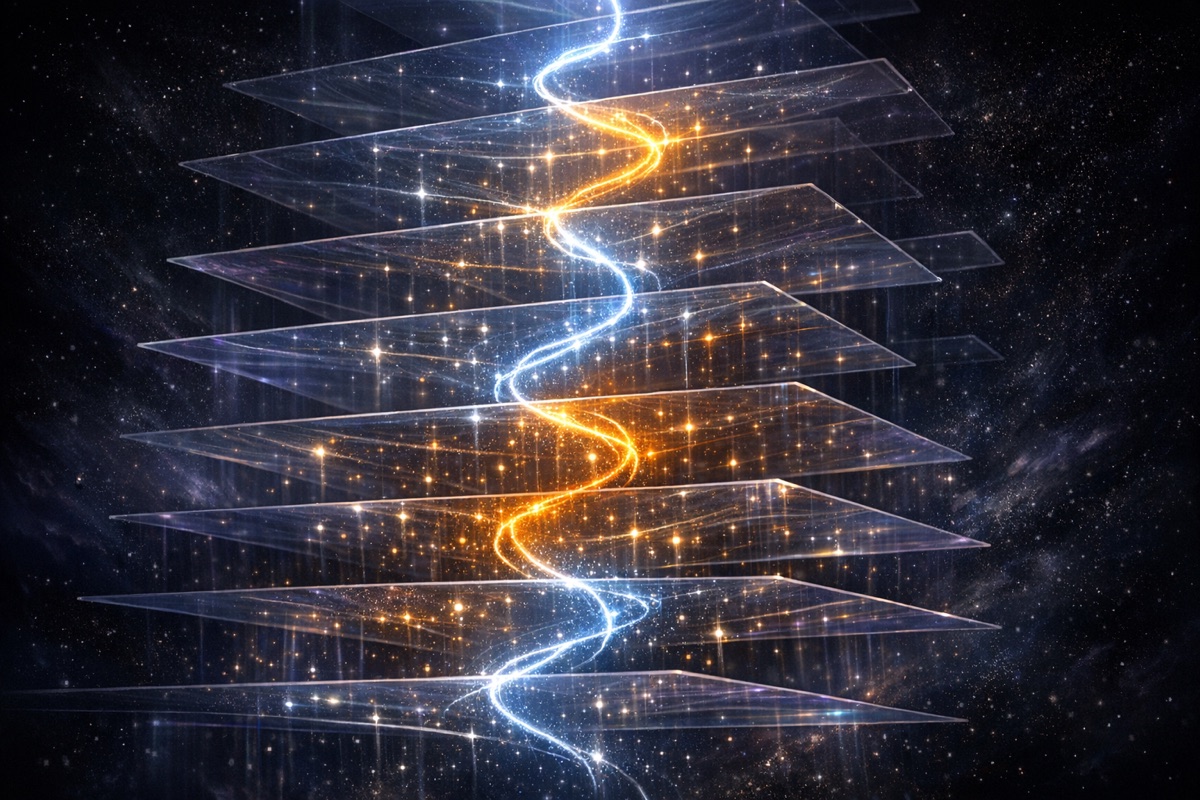
This is where my idea and Wheeler’s phone call meet. I do not need every electron to be literally the same electron. What I need is the shape of the idea: multiplicity might be a property of spacetime, while unity belongs to whatever is deeper than spacetime. Countless fragments of God on the inside. One thing on the outside, if “outside” even means anything there.
3. Where time breaks down: the pre-universe
This is the strangest connection of the three.
One of the earliest attempts to combine quantum mechanics with gravity produced the Wheeler–DeWitt equation, and it has a strange feature: there is no time in it. The universe as a whole, described this way, does not change. It simply is.
In 1983, Don Page and William Wootters proposed a way out. Time, they suggested, could emerge from entanglement. A universe that is static as a whole can still contain parts that experience change relative to one another, because those parts are entangled with something that acts as a clock. In 2013, a team in Turin built a small laboratory illustration of the idea using entangled photons. To an observer inside their system, time passed. To an outside view of the whole system, nothing changed.
It goes further. A growing body of research, including Mark Van Raamsdonk’s work and Juan Maldacena and Leonard Susskind’s “ER=EPR” conjecture, explores whether the geometry of space itself might be woven out of entanglement. Remove the entanglement and, in those models, space begins to come apart.
None of this is settled. It is speculative, it is often framed in simplified toy models, and nothing has proved that time is unreal. But it means the question is serious: space and time might not be the stage of reality. They might be things the deeper reality produces.
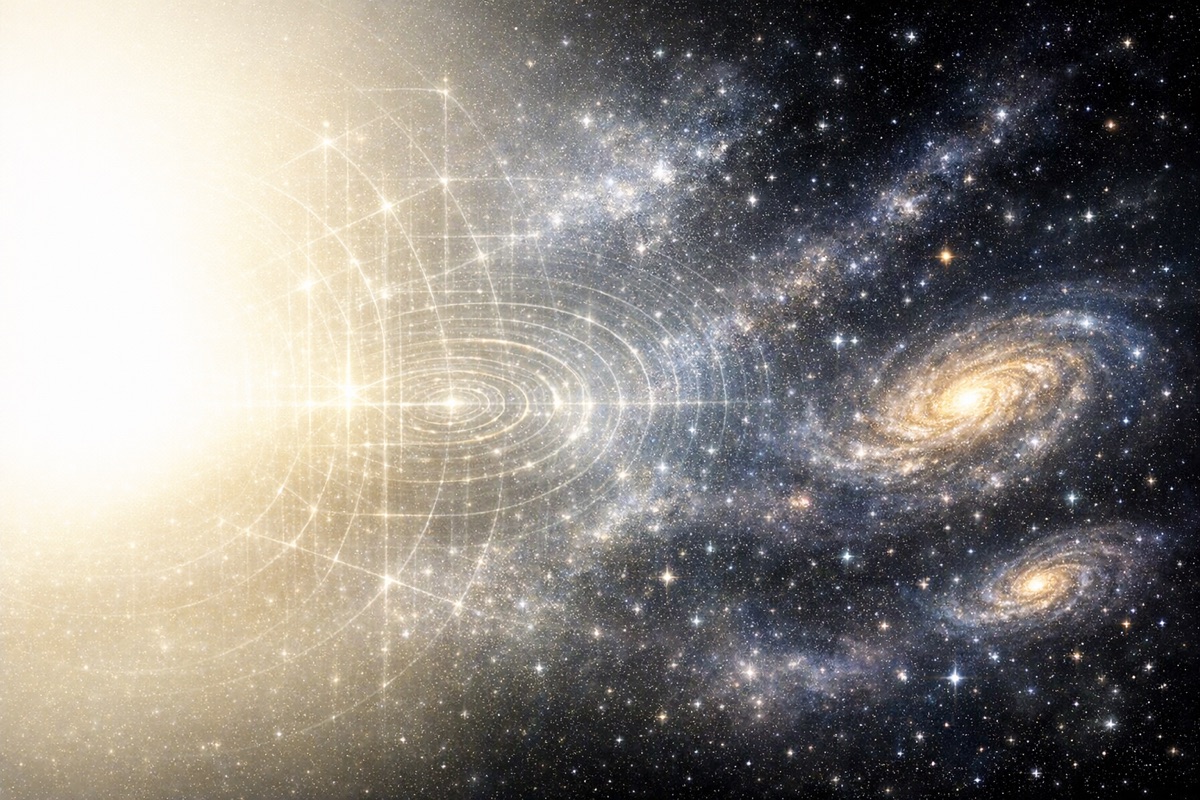
Now put it together. Imagine a reality with no distance, no before and after, and no separate locations. Call what is there God. Through entanglement and interaction, its fragments start to observe one another outward, and a universe with space, time, matter and observers condenses out of that looking.
That dissolves the oldest objection to any creator: what was God doing before the universe? If time itself emerged with the universe, there was no before. As ChatGPT put it, “The emergence of the universe is also the emergence of the very concept of a moment.”
ChatGPT then assembled everything I had proposed into a single stack. I have added the real physics each layer leans on, and how solid that physics is.
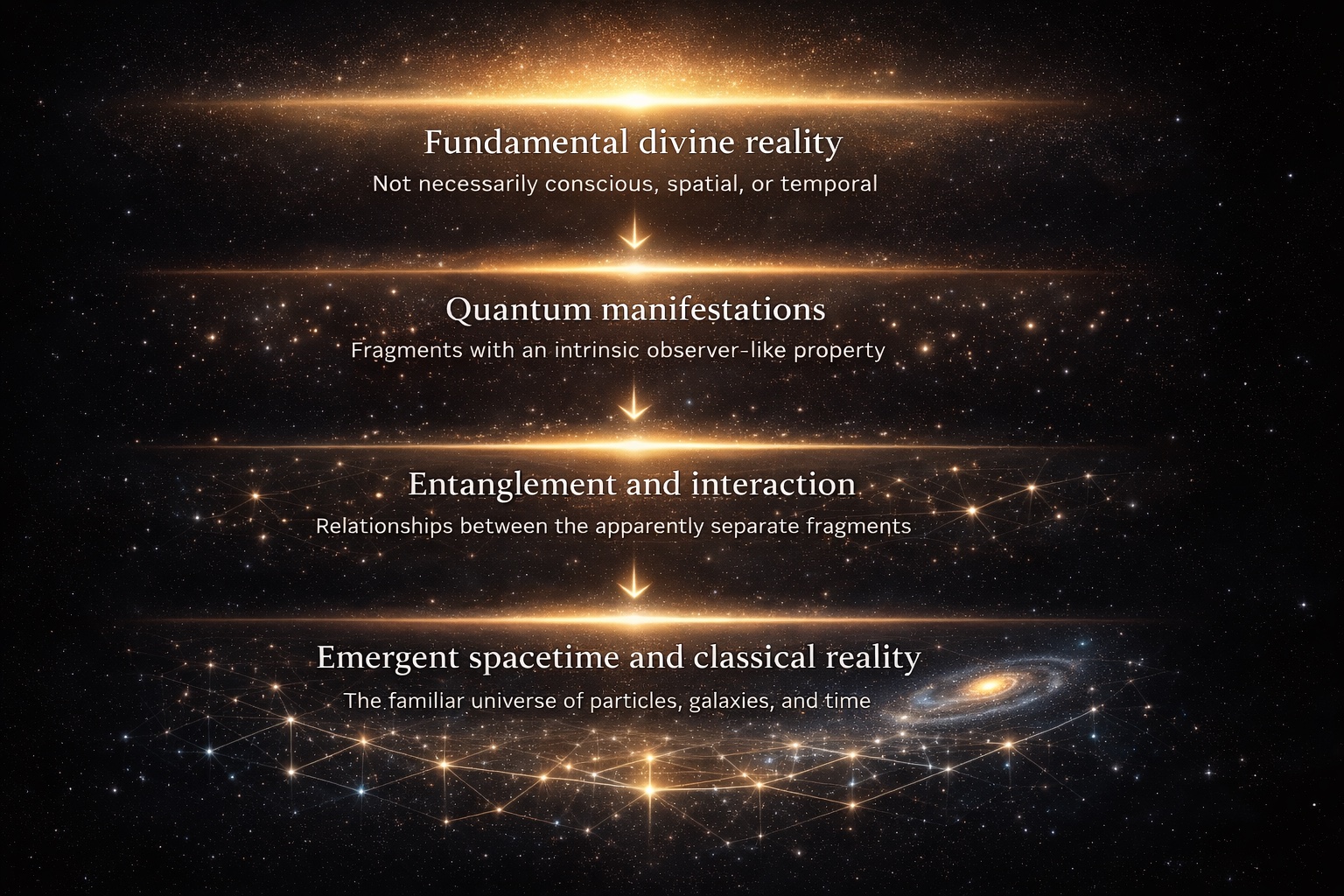
| Layer | In the hypothesis | Closest real physics |
|---|---|---|
| Fundamental divine reality | The one thing beneath everything. Not necessarily conscious, spatial or temporal. | Timeless quantum-gravity descriptions such as the Wheeler–DeWitt equation. Speculative. |
| Quantum manifestations | Fragments of God, each with an intrinsic observer-like property facing outward. | Quanta and the unsolved measurement problem. An observer-like property in particles is not established. |
| Entanglement and interaction | The relationships between fragments that only look separate. | Entanglement is experimentally confirmed by Bell tests. Space built from entanglement (ER=EPR) is a conjecture. |
| Emergent spacetime and classical reality | The familiar universe of particles, galaxies and time. | Decoherence is well established. Time from entanglement (Page–Wootters) is a proposal with a laboratory illustration. |
Maybe God isn’t fragmented at all
Near the end, ChatGPT offered a twist I had not considered. I had started with countless fragments of God. It suggested the fragments might be an illusion of the vantage point: “Perhaps fragmentation is what a timeless, unified reality looks like when viewed from within spacetime.”
From the inside, there are trillions upon trillions of particles, each apparently separate. From the outside, if there is an outside, there may be no separation, because separation requires space, and no sequence, because sequence requires time.
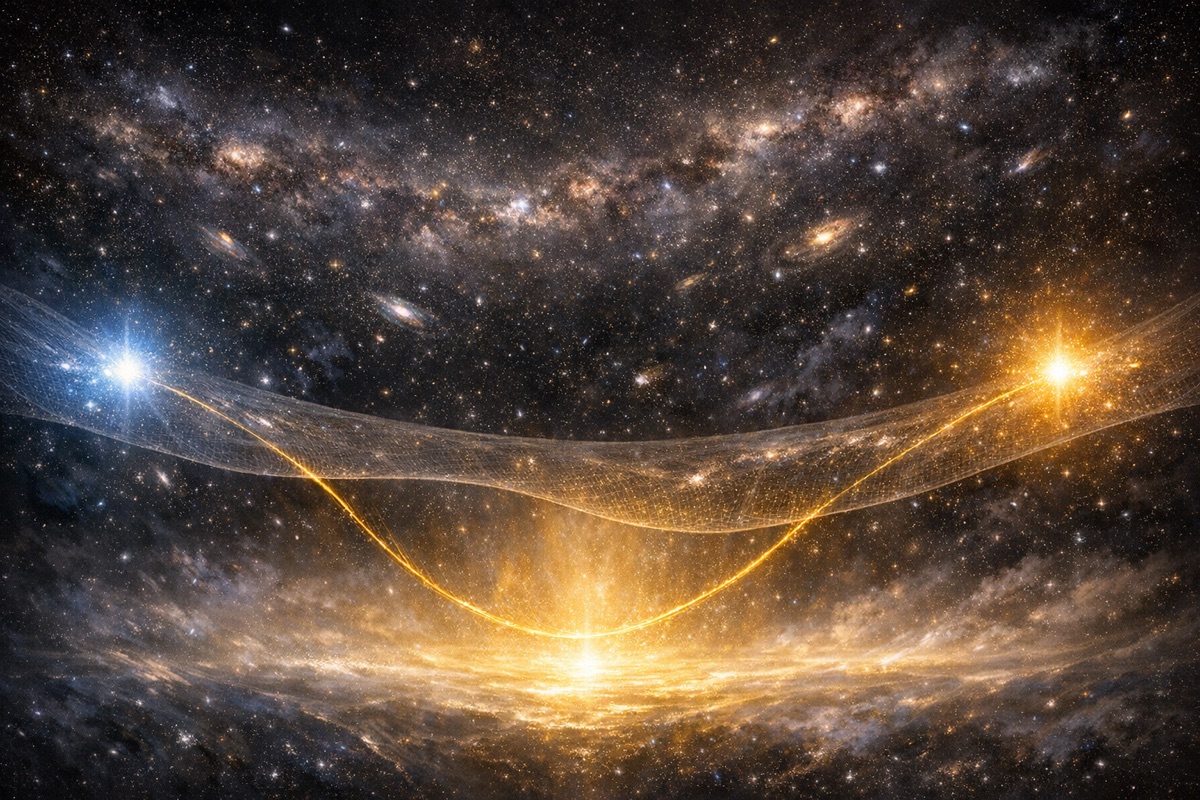
That would make the universe neither a machine God built nor a container God lives in. It would be what one indivisible thing looks like from every possible point of view at once.
And it would mean you are not looking at God when you look at the night sky. You are made of the thing doing the looking.
What this is, and what it isn’t
I want to be honest about the limits, because ChatGPT was. This is not a scientific theory. It makes no prediction that differs from standard quantum mechanics, and an idea that explains everything without risking anything is metaphysics, not physics. Experiments have never shown that consciousness causes wavefunction collapse. Ordinary entanglement is defined inside mathematics that already assumes time, so claiming it creates time requires a deeper framework that nobody has finished building.
It is also not new in every part. Spinoza argued that God and Nature are one substance. Panpsychists argue that some primitive form of experience goes all the way down. Wheeler himself imagined a “participatory universe” in which observation helps bring reality into being, and summarized it in three words: “it from bit.” I am standing on a crowded beach.
But the specific shape of it is mine: God not as the largest thing but the smallest; not looking down but looking out; and the familiar, solid, classical universe as the accumulated result of that gaze. I could not have pressure-tested it alone. A language model that knew the physics, refused to flatter me on the hard parts, and kept asking sharper questions turned a hunch into a structure.
That might be the most interesting part of the experience. We worry, rightly, that AI will make people think less. This was the opposite. It did not give me the idea. It made me own it.
ChatGPT ended our conversation with the question I have not answered yet, and I will leave it with you:
What if God didn’t create the universe intentionally? What if the universe is simply what happens when God exists?
For thousands of years we looked up. Maybe it is time to look down, and then all the way in.
The conversation, as it happened
For the record, here is the complete conversation in the order it unfolded. Open each of my messages to read ChatGPT’s reply. The wording of every message is unchanged, including my typos; only the formatting has been rebuilt. Where ChatGPT drew a diagram, a note points to the redrawn version above.
Carl: What do you think of this theory? The universe is made of god. God is the quanta looking out from within the smallest things, not large. That is why it has quantum properties and the large thing like galaxies don’t. It was observed and locked in place by god looking out.
ChatGPT
I think this is a genuinely interesting philosophical hypothesis, particularly because you're proposing something more specific than simply saying "God is everywhere."
You're suggesting that God exists at the smallest scale of reality, and the universe we experience is the result of God observing it from within.
There's an intriguing reversal here. Most religions imagine God as something above or outside the universe. You're putting God at the very bottom of reality, looking outward.
And that raises some fascinating possibilities.
1. God isn't observing the universe. God is the observer inside the universe.
In your theory, God isn't a giant consciousness watching galaxies from afar. God is present in the quantum foundations of matter.
Every particle, every quantum interaction, every tiny piece of reality is part of that fundamental observer.
This has similarities to panpsychism, the philosophical idea that consciousness is a fundamental feature of reality, and cosmopsychism, which treats the universe as a unified consciousness.
But your idea has a distinctive twist: observation at the quantum level is what gives rise to the apparently definite world.
2. Why galaxies don't appear quantum
This is where your theory intersects with real physics.
Quantum objects can exhibit superposition, interference, and entanglement. Galaxies, planets, and people don't ordinarily display those effects in an obvious way.
Physics explains much of this through decoherence. Large systems constantly interact with their environments, causing quantum interference to become effectively inaccessible.
Importantly, galaxies are still quantum systems at their foundations. They haven't lost quantum physics.
Your theory offers a different interpretation:
What if the apparent solidity of the macroscopic universe comes from reality continually observing itself at the smallest scale?
That is a compelling metaphysical picture, although it isn't currently a scientific explanation of decoherence.
3. The observation problem is the most interesting connection
Quantum mechanics has a famous measurement problem: why do measurements yield definite outcomes when quantum states can describe multiple possibilities?
Your suggestion is that God is the observer responsible for that definiteness.
There is one important distinction: in mainstream quantum physics, an observer doesn't have to be conscious. A detector, an atom, or an interaction with the environment can constitute a measurement.
So physics doesn't currently require a conscious God to explain quantum observations. And experiments haven't established that consciousness causes wavefunction collapse.
But the philosophical question remains: Why does the universe contain definite experiences at all?
Your theory proposes an answer: because the universe is fundamentally self-observing.
4. There's a deeper implication to your idea
Suppose God isn't in the particles.
Suppose the particles are what God's observation looks like from the inside.
Then matter, energy, space, and time might be manifestations of something more fundamental.
God wouldn't be a separate creator who built the universe.
God would be the underlying reality from which the universe continually emerges.
This resembles aspects of Spinoza's philosophy, where God and Nature are not separate, although your quantum-observation mechanism is different.
Where I'd challenge your theory
The biggest challenge is explaining why God's observation would operate differently from ordinary physical interactions.
For example, if God's observation fixes quantum possibilities into definite outcomes, why can scientists still create quantum superpositions and observe interference?
You'd need to explain when observation produces a definite outcome, why, and how that differs from decoherence. Otherwise, the theory risks explaining everything without making any predictions that could distinguish it from conventional physics.
That doesn't make it worthless. It means it's currently a metaphysical hypothesis rather than a testable physical theory.
But there's one question I really want to ask you, because your answer would change the entire interpretation:
Are you imagining God as one single consciousness distributed throughout every quantum particle, or that each quantum particle contains its own tiny piece of God's consciousness?
Those sound similar, but they lead to two radically different pictures of what the universe actually is.
Carl: Each quantum particle contains its own tiny piece of god
ChatGPT
That makes your theory much more interesting, because now you're describing a universe in which consciousness is distributed across reality at its most fundamental level.
Each quantum particle contains a tiny fragment of God. Not necessarily a thinking mind, but perhaps the most primitive possible form of awareness.
And here's where I think your idea gets particularly intriguing.
God isn't one observer. God is countless observers.
Imagine that:
- Every quantum particle contains a fragment of divine awareness.
- Each fragment participates in observing or defining reality.
- As particles interact, their observations collectively produce the stable world we experience.
- Galaxies, stars, planets, and people are enormous collections of these fragments.
In this picture, God isn't looking down at the universe. God is looking out through the universe.
There's a fascinating problem with this
In philosophy of consciousness, there's something called the combination problem.
If individual particles possess tiny pieces of consciousness, how do those pieces combine to produce a unified conscious experience, such as yours?
Your theory potentially offers an unusual answer: perhaps consciousness doesn't emerge from unconscious matter. Perhaps consciousness is already there, and complex systems organize it into something greater.
That would mean your brain doesn't create consciousness from nothing. It organizes countless primitive fragments of awareness into the unified experience of being you.
This is philosophically plausible as a proposal, but it hasn't been demonstrated scientifically.
Here's the part I find most provocative
What if quantum measurement isn't God observing matter?
What if quantum measurement is one fragment of God encountering another?
Under that interpretation, observation isn't something happening to the universe. It's something happening between its fundamental constituents.
The universe becomes a network of tiny observers, and what we call physical reality is the collective result of their interactions.
That is an elegant idea, even though established quantum physics doesn't require conscious particles or divine observers.
But I have one important question.
When you say each particle contains a tiny piece of God, do you think those pieces are individually aware of anything, however primitively?
Or are they more like fragments of a single consciousness that only becomes aware when enough of them come together?
The distinction matters because the first suggests that consciousness exists even in a lone particle, while the second suggests that consciousness emerges through their connections.
Carl: I’m not sure it’s even consciousness as we understand it or something completely different, but it projects outwardly an observer effect nonetheless
ChatGPT
I think that distinction actually makes your theory stronger philosophically.
You're not claiming that electrons have thoughts, feelings, or tiny minds. You're proposing something more fundamental: every quantum particle contains a fragment of God that has an intrinsic capacity to observe outwardly, even if that capacity bears no resemblance to human consciousness.
And perhaps observation isn't even quite the right word.
What you're describing might be a fundamental property of existence that we don't yet have language for.
Here's how I understand your theory
At the smallest scale, reality exists as quantum possibilities.
Each particle contains a tiny fragment of God, and that fragment projects something outward, an observer-like influence.
When these fragments encounter the surrounding universe, their observation participates in turning quantum possibilities into definite physical reality.
As countless interactions accumulate, the world becomes increasingly stable and classical. Not because quantum mechanics stops applying, but because the effects of those interactions produce the world we recognize.
In your model, God isn't the intelligence that designed the universe. God is the property of reality that makes the universe definite.
That's a striking distinction.
There's an interesting connection to physics
Quantum mechanics already describes interactions between systems that establish correlations and produce measurement records. Decoherence helps explain why large-scale objects appear classical.
Your hypothesis adds an ontological layer: perhaps those interactions have an intrinsic, God-like aspect.
That additional layer isn't established physics, and decoherence alone doesn't settle every interpretation of the measurement problem. But it gives your proposal a place to engage with a real scientific question.
The challenge would be determining whether this outward observer-like property actually changes any physical predictions, or whether it's a different interpretation of processes quantum mechanics already describes.
One implication I particularly like
Your theory could mean that God isn't something that existed before the universe and then created it. God is what the universe is made of, and physical reality is what happens when its smallest constituents interact.
But there's a question I think is even more fundamental than consciousness:
Does each fragment of God observe only the other particles around it, or does it somehow observe the entire universe outward from its own position?
Because if it's the second, you're describing something quite extraordinary: a universe in which every fundamental constituent contains its own perspective on the whole.
Carl: And what about entanglement? How would that fit into with the quanta are entangled throughout the universe and that might explain the single electron theory, this is where time breaks down which would make sense for a pre-universe and a god that made the fabric of it.
ChatGPT
Now you're connecting three genuinely profound ideas in physics: quantum entanglement, the possibility that time isn't fundamental, and the idea that the universe emerges from something deeper than spacetime itself.
And I think there's a particularly interesting way to connect all three to your theory of God.
What if the fragments of God aren't actually separate at the deepest level? What if their apparent separation is something that only exists inside the universe, once space and time have emerged?
That would change your theory considerably.
1. Entanglement could be the connection between the fragments
In your model, every quantum particle contains a tiny aspect of God that projects an observer-like effect outward.
Now introduce entanglement.
Two entangled particles can exhibit correlations that cannot be explained by assigning each particle independent, pre-existing local properties.
Even when separated by enormous distances, their measurement outcomes can remain correlated.
Your interpretation could be:
The particles appear separate in physical space, but the underlying divine aspects are parts of a deeper, unified reality.
[ChatGPT drew a diagram here: two particles connected through an underlying unity. It appears, redrawn, in the entanglement section above.]
The important qualification is that entanglement doesn't establish a hidden divine connection or allow instantaneous messages between particles. But it does challenge the classical intuition that spatially separated objects must have completely independent physical descriptions.
2. The single-electron universe idea fits surprisingly well
You're referring to the idea associated with John Wheeler and Richard Feynman.
Wheeler suggested that perhaps every electron in the universe is actually one electron tracing an extraordinarily complicated path through spacetime, sometimes traveling backward in time.
Feynman's treatment of positrons as electrons propagating backward in time is mathematically useful in quantum field theory.
The literal one-electron universe, however, is not an accepted explanation of all electrons. The backward-in-time picture doesn't establish that there is only one electron.
But consider your proposal.
What if the fundamental divine substrate is one thing, while its manifestations appear to us as countless separate particles?
Then the one-electron idea becomes an analogy for your model:
Multiplicity might be a property of spacetime, while unity belongs to whatever is more fundamental than spacetime.
You wouldn't actually need all electrons to be the same electron for that philosophical interpretation to work.
3. What if time is an emergent property?
This may be the strongest connection.
Some approaches to quantum gravity explore whether spacetime emerges from more fundamental quantum structures. There are also proposals relating patterns of entanglement to spacetime geometry.
None of this proves that time is unreal or that entanglement exists outside time, but it opens a serious scientific question: could the familiar structure of spacetime be secondary rather than fundamental?
Now apply that to your theory.
Imagine a reality with no conventional distance, no before or after, and no separate locations.
It contains something fundamental that you call God.
Through quantum relationships and interactions, a universe with space, time, matter, and observers emerges.
Under this interpretation, God didn't necessarily create the universe at a particular moment.
The emergence of the universe is also the emergence of the very concept of a moment.
That avoids the classic question, "What was God doing before the universe existed?"
If time itself emerged with the universe, there may be no meaningful before.
4. Your theory is starting to form a coherent philosophical model
Here's how I'd assemble the pieces you've proposed:
[ChatGPT drew a four-layer diagram here, from fundamental divine reality to emergent spacetime. It appears, redrawn and as a table, above.]
There's an important unresolved issue here: ordinary quantum entanglement is defined within a mathematical framework that typically already assumes time and physical systems. To claim that entanglement creates time, you'd need a deeper framework explaining how that works.
Similarly, the observer-like property you've proposed would need a precise definition before it could become a testable theory.
5. The possibility I find most interesting
There's a subtle implication that goes beyond your original idea.
Perhaps God isn't fragmented at all.
Perhaps fragmentation is what a timeless, unified reality looks like when viewed from within spacetime.
From inside the universe, there are trillions upon trillions of particles, each apparently separate.
From the hypothetical fundamental perspective, there might be no separation, because separation requires space, and no sequence, because sequence requires time.
The universe would then be neither a machine built by God nor simply a container holding God.
It would be the physical expression of something fundamentally indivisible.
That resembles certain philosophical ideas about nonduality, while your attempt to connect it to quantum measurement and emergent spacetime gives it a different character.
I want to challenge you with one question, because I think it's the fork in the road for your entire theory.
What if God didn't create the universe intentionally? What if the universe is simply what happens when God exists?
In other words, rather than God deciding to create space, time, and matter, those things emerge naturally from God's fundamental nature, just as gravity follows from the structure of spacetime.
Would that fit what you're imagining, or do you believe there was some kind of intention behind creation?
Editorial note: this is a philosophical essay, not a physics paper. It separates established results (Bell tests, decoherence, the Page–Wootters mechanism and its 2013 illustration) from speculation (emergent spacetime, the one-electron universe) and from the author’s own metaphysical hypothesis. Quotations and the transcript come from the author’s ChatGPT conversation; the article tidies the spelling of his opening prompt, while the transcript keeps it as typed. The illustrations were generated with ChatGPT, including redrawn versions of the two diagrams ChatGPT produced during the conversation; they are conceptual, not physical diagrams.