
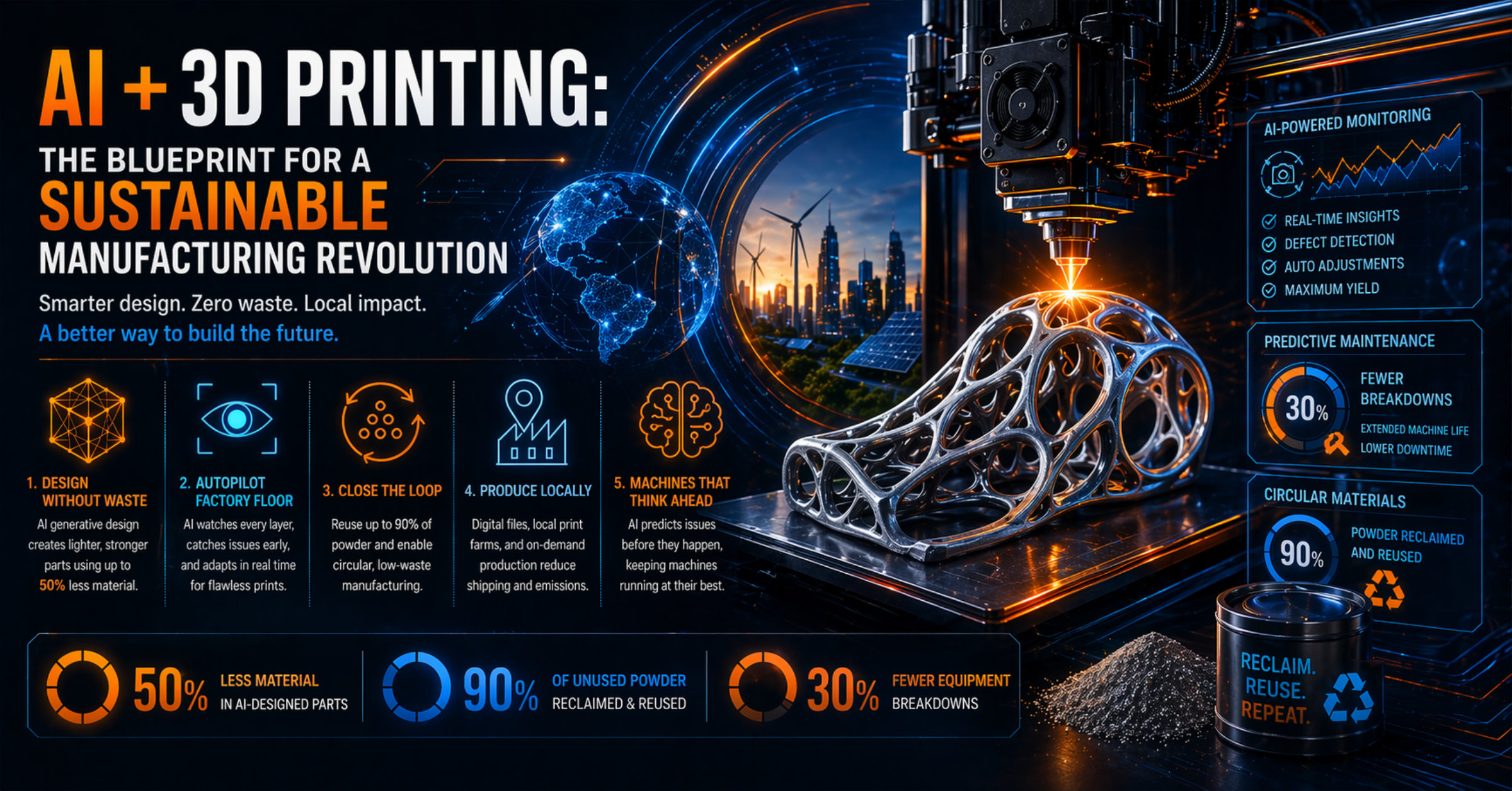
For years, manufacturing has lived with a bad bargain: if you wanted more output, you usually accepted more waste, more energy use, and more emissions. That tradeoff is starting to crack. AI and additive manufacturing are beginning to change the model itself, turning production into something more precise, more responsive, and far less wasteful. NIST now highlights generative design and predictive maintenance among the ways AI is already reshaping manufacturing, while the U.S. Department of Energy points to additive manufacturing as a path to lower material use, lower energy use, and lower emissions.
That is what makes the AI plus 3D printing story so compelling. This is not just about making cool parts faster. It is about building a manufacturing system that thinks harder before it makes, prints only what it needs, catches problems while they are still small, and gets more life out of both materials and machines. That is not a minor upgrade. That is a rewrite of the production playbook.
1. Design out the waste before the first print even starts
Traditional manufacturing often begins with a fixed design, then works backward through tooling, machining, and all the waste that comes with it. AI-driven generative design flips that logic on its head. Engineers define the goal, the loads, the constraints, and the material, then software explores the design space at speed. NIST’s additive manufacturing reference model notes that topology optimization and generative design are specifically used to reduce design volume while still meeting structural requirements.
That matters because the sustainability win starts long before the machine turns on. When a part is designed to use less material and still perform, everything downstream gets better. There is less feedstock to buy, less scrap to handle, less weight to move, and often less energy tied up across the product lifecycle. In one DOE-cited aircraft bracket case, an optimized additive design was 65% lighter, used 93% less raw material, and delivered 66% total lifecycle energy savings compared with the conventional version. That is the kind of result that changes the conversation, because it ties sustainability directly to performance and cost.
2. Turn the printer into something closer to an autopilot system
The second big shift is operational. AI is moving additive manufacturing away from passive machine execution and toward active process intelligence. Recent reviews of the field point to AI, machine learning, and digital twins as key enablers for real-time process monitoring, quality assurance, and predictive maintenance in additive manufacturing systems.
In plain English, that means the printer is no longer just following instructions. It is increasingly able to watch the build, spot drift, flag anomalies, and help correct issues before they turn into ruined parts, wasted powder, and lost machine time. For any manufacturer trying to reduce scrap and stabilize quality, that is a massive shift. It is greener, yes, but it is also simply smarter operations.
3. Stop treating leftover material like dead weight
One of the most interesting parts of the additive manufacturing story is how naturally it fits a more circular mindset. In powder bed fusion, a large portion of feedstock can remain unused after a build, which is exactly why powder reuse has become such an important focus. A 2024 review in the Journal of Manufacturing Processes describes powder reuse as crucial to both the financial viability and the environmental impact of metal additive manufacturing, while also emphasizing that reuse needs careful controls because powder properties change over time.
That is where AI can make the whole system better. Instead of treating reuse as a rough manual judgment call, manufacturers can use data to decide when powder can be refreshed, blended, or retired. The result is simple and powerful: less waste, better consistency, and a tighter loop between production and material recovery. DOE’s advanced manufacturing strategy also explicitly points to reuse, recycling, and circular manufacturing as part of the path to decarbonization.
4. Manufacture closer to where products are actually needed
The old industrial model loves scale, but it also loves distance. Big factories. Big inventories. Long shipping routes. A lot of friction between where something is made and where it is used. Additive manufacturing opens the door to a different model because production can travel as a file before it travels as a finished good. The World Economic Forum has noted that local 3D printing can reduce logistics and transportation costs because production becomes more localized and immediate, and its 2022 additive manufacturing guidance frames the technology as an enabler of on-demand and decentralized production.
That is not just efficient. It is resilient. It means smaller inventories, fewer unnecessary shipments, and more flexibility when supply chains get messy. In a world where speed, resilience, and sustainability increasingly show up in the same conversation, that combination is hard to ignore.
5. Keep machines alive longer and surprises smaller
Downtime is one of the least glamorous problems in manufacturing, but it is also one of the most expensive and wasteful. When equipment fails unexpectedly, production stops, scrap rises, repairs get rushed, and the whole operation gets more wasteful in a hurry. That is why predictive maintenance matters so much. NIST lists predictive maintenance as one of the practical ways AI is already improving manufacturing, and McKinsey has reported that predictive maintenance can reduce machine downtime by 30% to 50% while increasing machine life by 20% to 40%.
For additive manufacturing, the implication is obvious. Printers that can signal trouble early, whether it is vibration drift, thermal irregularity, or component wear, are not just easier to manage. They are more sustainable assets. You get more output from the same equipment, fewer emergency interventions, and less waste created by preventable failures.

Why this matters now
What makes AI plus 3D printing so powerful is that it attacks the waste problem from multiple angles at once. It improves design before production begins. It reduces scrap while the part is being built. It supports reuse and circular material strategies after the build. It shortens supply chains by making localized production more realistic. And it helps machines run longer and better with fewer surprises. Taken together, that is not a small efficiency play. It is a very different manufacturing model.
The companies that win in this next chapter will not be the ones that simply print more parts or bolt AI onto yesterday’s factory. They will be the ones that use intelligence to design out waste, build closer to demand, recover more value from materials, and run operations with far more precision. Cleaner, faster, smarter manufacturing is no longer a concept piece. It is already taking shape. The only real question is who moves early enough to lead it.