
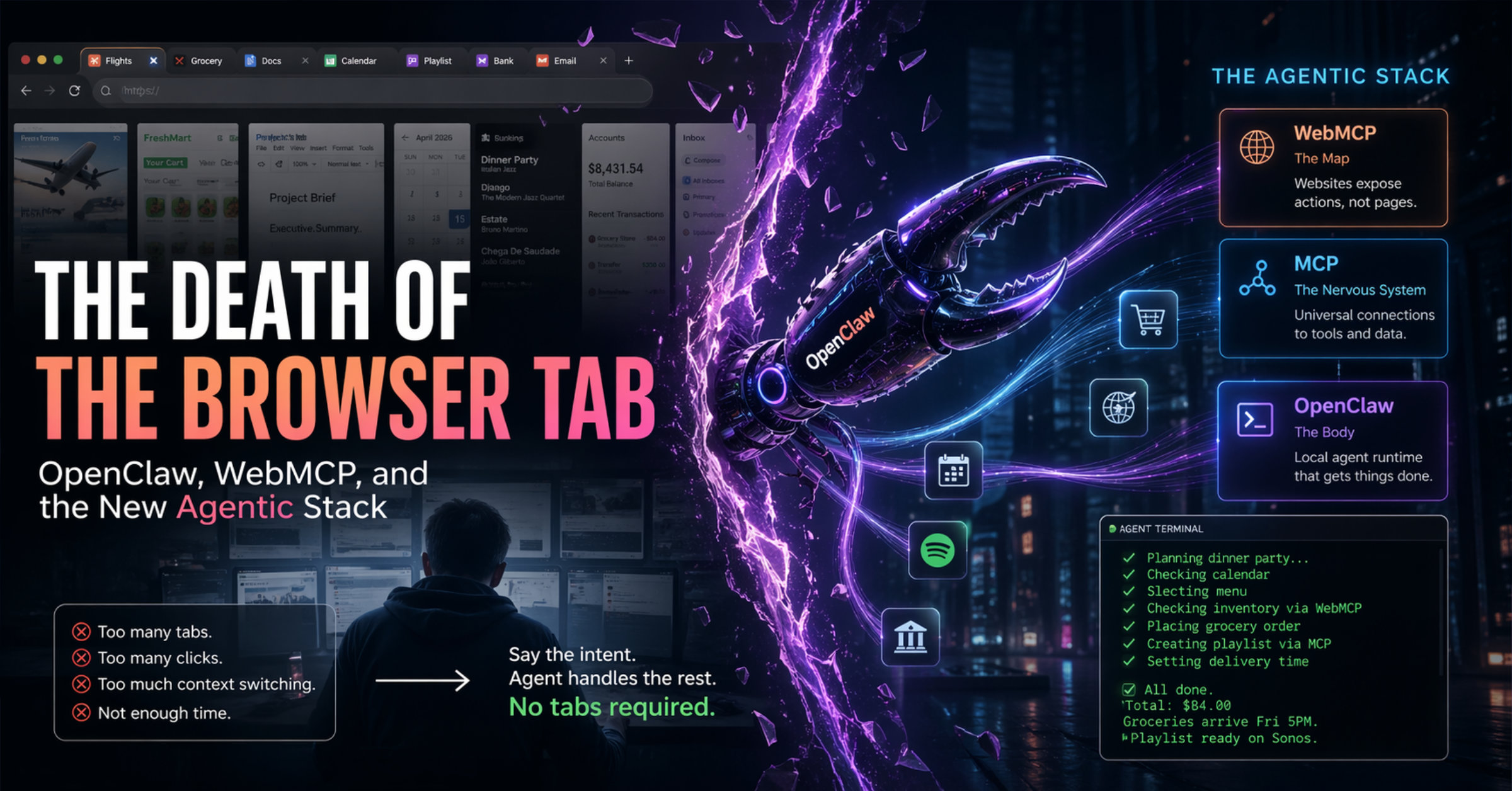
If you have spent any time on X, in the AI corners of GitHub, or lurking around Moltbook lately, you have felt the temperature change. The screenshots got louder. The demos got weirder. The line between “assistant” and “operator” started to blur. OpenClaw is no longer being treated like a clever side project. Its creator joined OpenAI in February, the project is moving into a foundation, and Moltbook itself was acquired by Meta in March. That is not novelty energy. That is platform energy.
For the last few years, most of us have been talking to AI like it was a better search box or a very caffeinated intern. Ask a question. Get an answer. Rewrite a paragraph. Summarize a document. Useful, absolutely. But still mostly passive.
That is what is changing now.
The last era of AI was about conversation. The next one is about agency.
OpenClaw gives AI a runtime that can actually do things on hardware you control. MCP gives the ecosystem a standard way to connect models to tools, data, and workflows. WebMCP gives websites a structured way to expose actions to browser agents, instead of forcing them to stumble through the UI like a robot pretending to be a human with a mouse. Chrome is also explicit about something important here: WebMCP is not a replacement for MCP. The two are meant to work together.
That is the real story. We are moving out of the era of chat interfaces and into the era of intent interfaces.
The browser tab is not disappearing tomorrow morning. But it is starting to lose its monopoly. More and more, the tab becomes just one surface among many, while the agent runtime becomes the real center of gravity. That is still an inference, not a finished reality, but it is exactly where the tooling is headed. MCP handles persistent access to systems and workflows. WebMCP handles live, in-tab interaction while a user is on a site. One is the backplane. The other is the storefront.
OpenClaw is the part that gave AI hands
This is why OpenClaw hit such a nerve. It is not being framed as “a smarter chatbot.” It is a self-hosted personal assistant you run on your own devices, across channels you already use. The official docs describe it as a gateway that connects chat surfaces like Discord, iMessage, Signal, Slack, Telegram, and WhatsApp to an always-available assistant, while its tool system lets the agent read files, run commands, browse the web, send messages, and interact with devices. That is a very different category of product.
This is the leap a lot of people missed. The model is only part of the value. The real shift happens when intelligence gets wrapped in memory, permissions, tools, routing, sessions, and execution. At that point, you are no longer asking software to help you think. You are asking software to help you finish.
Old AI handed you a script. Agentic AI starts leaning toward completion.
That is a massive change in feel. It stops being “here is how you might do this” and starts becoming “I handled it.”
Human view: A beautiful webpage with images of beaches and a complex date picker.
Agent view (WebMCP): JSON
{
  "tool": "book_flight",
  "schema": { "destination": "string", "date": "ISO8601", "class": "economy|business" }
}
MCP is the connector that makes the whole thing scale
MCP matters because nobody wants a future where every agent needs a custom integration for every app, database, and workflow. The official MCP docs describe it as an open-source standard for connecting AI applications to external systems, and the comparison they use is basically USB-C for AI. That analogy stuck because it captures the point cleanly: a shared contract beats a thousand brittle one-offs.
This is where the bigger shift shows up. Before standards, agents are impressive demos. After standards, agents become infrastructure. Once tools, data sources, and workflows can be exposed in a common way, the whole ecosystem gets easier to compose. Developers build less glue. Assistants become less siloed. The market gets a lot more interoperable.
That does not mean every product supports every MCP scenario perfectly today. It does mean the direction is now obvious. The industry finally has a credible answer to a problem it badly needed to solve: how models reach beyond the chat box and do useful work without every connection turning into a custom science project.

Automating your life
WebMCP is the piece that could change the web itself
This is the part I think people are still underestimating.
Right now, a lot of agentic browsing is basically expensive puppeteering. Open a page. Parse the DOM. Hunt for buttons. Hope the CSS changed in a friendly way. Pray the checkout flow did not move a field or rename a class. It works, but it is clumsy, brittle, and token-hungry.
WebMCP is Chrome’s early-preview attempt to fix that. The Chrome team says it gives websites structured ways to expose actions to browser agents through declarative and imperative APIs, making agent interactions faster, more reliable, and more precise than raw DOM actuation. It is also still early preview, which matters. This is direction, not full deployment.
That distinction matters because it reframes the future of websites. The current web is built around making humans click. The agentic web also needs a layer that makes machines understand what actions are available, what inputs they need, and what outcomes they can expect. Not every site will expose that soon. But once that pattern starts working, the logic is hard to ignore. Websites will increasingly have two faces: one for humans, one for agents.
And Chrome’s own explanation sharpens the point. MCP is for backend connectivity that works across platforms and outside the browser. WebMCP is for live, contextual, tab-bound interaction. Persistent versus ephemeral. System access versus site access. They are not rivals. They are layers.
What this actually changes for regular people
Here is what this looks like when it matures.
You stop being a tab babysitter.
Instead of opening five sites, comparing options, copying data between apps, and fighting a checkout flow, you express intent once. The agent handles the search, context gathering, tool selection, and execution path. A local agent runtime keeps your preferences and operating context close to you. MCP-connected systems expose the tools and data. WebMCP-ready sites expose the live actions when the browser needs to be part of the loop. The human moves up a level, from operator to reviewer, approver, and exception handler. That specific end state is still an inference, but it is the most logical reading of where these technologies are headed together.
That is why I think “the death of the browser tab” is the right metaphor, even if the phrase is intentionally dramatic. The tab is not dead. It is being demoted.

The part that should make everyone slow down
Now for the uncomfortable part.
When people get excited about agentic systems, they tend to focus on the magic. They should spend more time thinking about the blast radius.
OpenClaw’s own security guidance is blunt. It assumes one trusted operator boundary per gateway and explicitly says it is not a hostile multi-user security boundary for adversarial users sharing one agent or gateway. Its onboarding flow now defaults local setups to a more constrained coding tool profile rather than an unrestricted full profile. MCP’s security guidance is equally direct, warning implementers about issues like confused deputy problems, SSRF, session hijacking, local server compromise, and the need for scope minimization.
And the risks are already real, not hypothetical. VirusTotal reported in February that it had detected hundreds of malicious OpenClaw skills, describing the ecosystem as a new supply-chain attack surface. OpenClaw responded by announcing VirusTotal scanning for skills published to ClawHub, including daily rescans and automatic blocking for malicious verdicts. When the builders are racing to add threat scanning that quickly, you should assume the attack surface is already here.
This is why the real moat in the next wave of AI may not just be model quality. It may be trust design. Permission scoping. Auditability. Sandboxing. Approval flows. Safe defaults. The most valuable agent will not be the one that feels smartest in a demo. It will be the one you can actually trust with real authority.
The verdict
So no, the browser is not gone. But the center of gravity is moving.
OpenClaw and projects like it show what happens when AI gets hands. MCP gives those hands a standard way to reach into tools and data. WebMCP gives the public web a cleaner way to meet those hands halfway. Put them together, and the interface stops being a place you visit and starts becoming something that works on your behalf.
The old web was built for clicks. The next layer of the web is being built for intent.
And once that shift lands, the companies that win may not be the ones with the prettiest pages. They may be the ones that make themselves easiest for trusted agents to understand, negotiate with, and execute against. That is the deeper story behind the OpenClaw moment. Not a viral repo. Not a weird social feed for lobsters. A serious change in how computers are going to get used.